
- OpenAI launches ChatGPT Health for dedicated health conversations
- You can securely upload your medical records and connect apps like Apple Health
- You can join the waitlist to access the new tool now
Hot on the heels of news that 40 million people are already using ChatGPT for healthcare questions every day, OpenAI has announced a new dedicated health tool called ChatGPT Health.
While medical matters are already one of the most common things people ask ChatGPT about, it will now have its own dedicated space inside the app, designed specifically for these types of conversations.
The key feature of ChatGPT Health is the ability to securely connect your own medical records and wellness apps (such as Apple Health, Function, and MyFitnessPal), grounding responses in your personal health data. The result is a more personalized and, ultimately, more useful experience when you’re asking questions, deciphering messages from your doctor, or trying to understand test results.
Regarding apps like Apple Health, ChatGPT says you'll be in full control of how much access they have: “The first time you connect an app, we’ll help you understand what types of data may be collected by the third party. And you’re always in control: disconnect an app at any time and it immediately loses access.”
OpenAI says it has worked with more than 260 physicians across 60 countries and dozens of specialties to help refine how ChatGPT Health responds, when it should recommend follow-ups with a physician, and how to communicate clearly without oversimplifying.
Can you trust AI advice?
We all know that AI chatbots can hallucinate answers to questions, which is OpenAI’s way of saying that it can just make stuff up, so the immediate question that springs to mind is: can you trust AI for medical advice?
OpenAI neatly dodges this issue by saying, “Health is designed to support, not replace, medical care. It is not intended for diagnosis or treatment. Instead, it helps you navigate everyday questions and understand patterns over time — not just moments of illness — so you can feel more informed and prepared for important medical conversations.”
By removing the responsibility for diagnosis and treatment, OpenAI is reminding you that ChatGPT shouldn’t be relied on for solid answers all that time, especially when it comes to something as important as medical advice, and is shifting its role to more of a supporting service to help you understand the information you’ve been given.
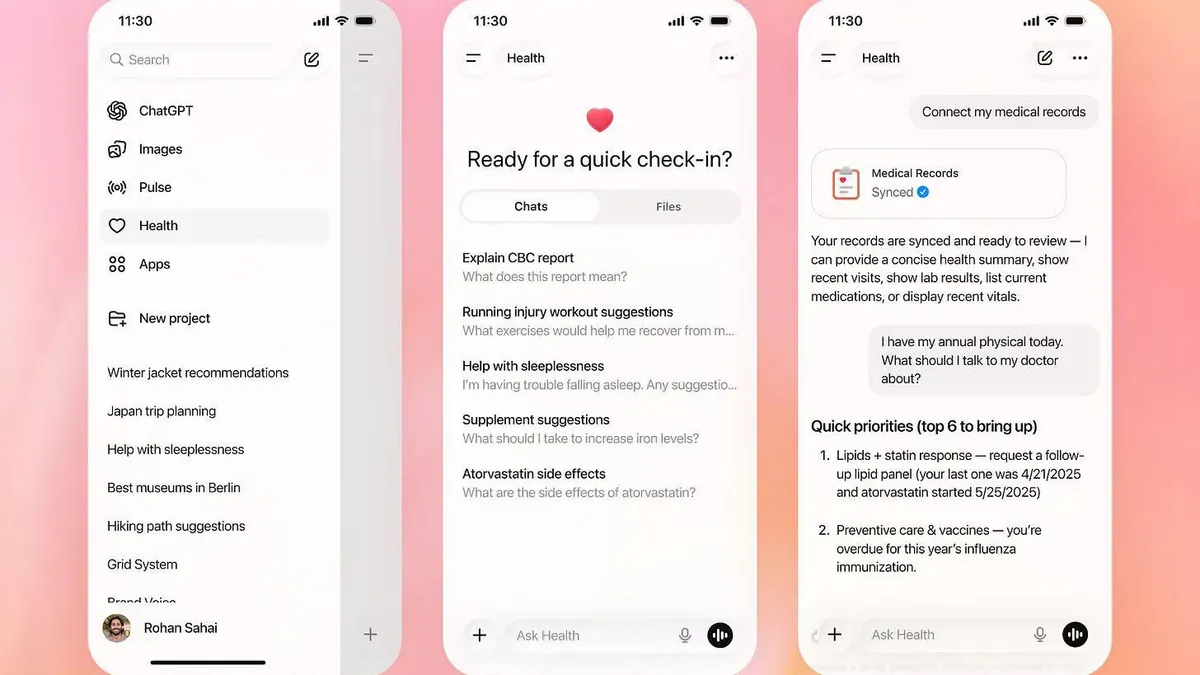
ChatGPT Health in use
Videos posted by OpenAI on X show ChatGPT Health appearing as an option in the main left-hand menu bar under 'Health', and being used for general queries such as, “I have my annual checkup with my physician tomorrow — what should I ask?”
If you choose, ChatGPT Health lets you securely connect medical records and apps like Apple Health, MyFitnessPal, and Peloton to give personalized responses. pic.twitter.com/Nv5sA2ifrVJanuary 7, 2026
Another video shows ChatGPT Health pulling in data from Apple Health and suggesting a workout routine designed to improve your fitness based on your current activity levels.
There’s also an example of how the tool works once you’ve uploaded your medical records, including comparing insurance plans to help you decide which option might be best for you.
But is your medical data safe?
Giving OpenAI access to your health records inevitably raises concerns about privacy and security. Health information is among the most sensitive data we possess, and the thought of handing it over to a partly for-profit company will make many people uneasy.
To address those concerns, OpenAI says: “We recognize that people share personal and sensitive information with ChatGPT. That understanding shapes how we design the security, privacy, and data controls for all of our products — from the start. Even before introducing ChatGPT Health, we built foundational protections across ChatGPT to give you meaningful control over your data, including temporary chats, the ability to delete chats from OpenAI’s systems within 30 days, and training our models not to retain personal information from user chats.”
It continues: “Conversations and files across ChatGPT are encrypted by default at rest and in transit as part of our core security architecture. Due to the sensitive nature of health data, Health builds on this foundation with additional, layered protections — including purpose-built encryption and isolation — to keep health conversations protected and compartmentalized. Conversations in Health are not used to train our foundation models.”
In short, your health data won’t mix with your everyday ChatGPT conversations — it’s kept entirely separate.
How do I access ChatGPT Health?
ChatGPT Health isn’t widely available yet. To access it, you’ll need to join a waitlist. ChatGPT users on Free, Go, Plus, and Pro plans outside of the European Economic Area, Switzerland, and the United Kingdom are currently eligible.
That restriction may not last long, though. OpenAI says it plans to expand access to all users on web and iOS in the coming weeks.
OpenAI describes ChatGPT Health as “supporting, not replacing, care from clinicians,” but with millions of people already relying on ChatGPT for medical guidance this launch makes one thing clear: AI is set to play an increasingly central role in how we engage with healthcare in the future.
Follow TechRadar on Google News and add us as a preferred source to get our expert news, reviews, and opinion in your feeds. Make sure to click the Follow button!
And of course you can also follow TechRadar on TikTok for news, reviews, unboxings in video form, and get regular updates from us on WhatsApp too.

➡️ Read our full guide to the best business laptops
1. Best overall:
Dell Precision 5690
2. Best on a budget:
Acer Aspire 5
3. Best MacBook:
Apple MacBook Pro 14-inch (M4)

You must confirm your public display name before commenting
Please logout and then login again, you will then be prompted to enter your display name.